Friday, March 29, 2013

High Tunnel is Up! Many Thanks to our Helpers!

We finished putting on the plastic this morning.
The high tunnel is just about finished, and we wanted to say a huge "thank you" to all of you who helped us make this happen! Special thanks to our WWOOF volunteer, Madeline, who put in several 10-hour+ days on this project and our neighbor, Dan, who gave us free reign of his tool shed all week and to Mike from People and Planet who kept us fueled up with a big box of bananas and apples. Also much thanks to Bart, Pieter, Nineveh, Ariella, Jynelle, Kyrod, Tim, Craig, Lynn, and Nina who all gave up part of their weekend and plenty of sweat to get it done.

Hanging the first door.

Lots of drilling into steel on ladders- hard work!

Shoveling gravel under the baseboards - also a good workout!
Putting up purlins.


Ladders moving everywhere.


More drilling on ladders.

Victorious!


Monday, March 18, 2013

It's a Barn Raising!

Saturday and Sunday March 23rd and 24th, from 10am-5pm

This is the first arch. We have 11 more to go!
Gal has been busy with the sledgehammer.
It’s actually a high-tunnel raising, but same concept. A barn raising is when members of a community come together to help assemble and raise the frame of a barn — or in our case, a high-tunnel — which is too big a job for the farmers to do alone. A high-tunnel is a type of greenhouse, basically a big metal frame covered with plastic, which we will plant under. We were awarded a grant from NRCS to purchase this high-tunnel, and we need to finish assembling it in time for our April planting. So the race is on!

The posts that form the foundation are already in place, and it’s time to put up those big metal hoops. This is a big job, and we are humbly requesting the help of our community of friends, neighbors, and CSA members. You do not have to be an experienced construction worker or super-strong to help out. Jobs will include piecing together the metal hoops, helping to hoist them into place, and bolting together the supporting pieces. If you have a drill, please bring it. Also, we are greatly in need of a tall, free-standing (A-frame) ladder, 10 feet or taller. The barn raising is both Saturday and Sunday. We hugely appreciate any help you can provide, whether for an hour or a day. We hope this will be a fun community-building time with a sense of accomplishment at the end. We will provide cold drinks and light refreshments.

All are welcome. Many hands make light work.

900 W. Edmundson Ave., Morgan Hill

Thank You,
Michelle and Gal

The finished product should look something like this.


Thursday, March 14, 2013

When Life Gives You Lemons....

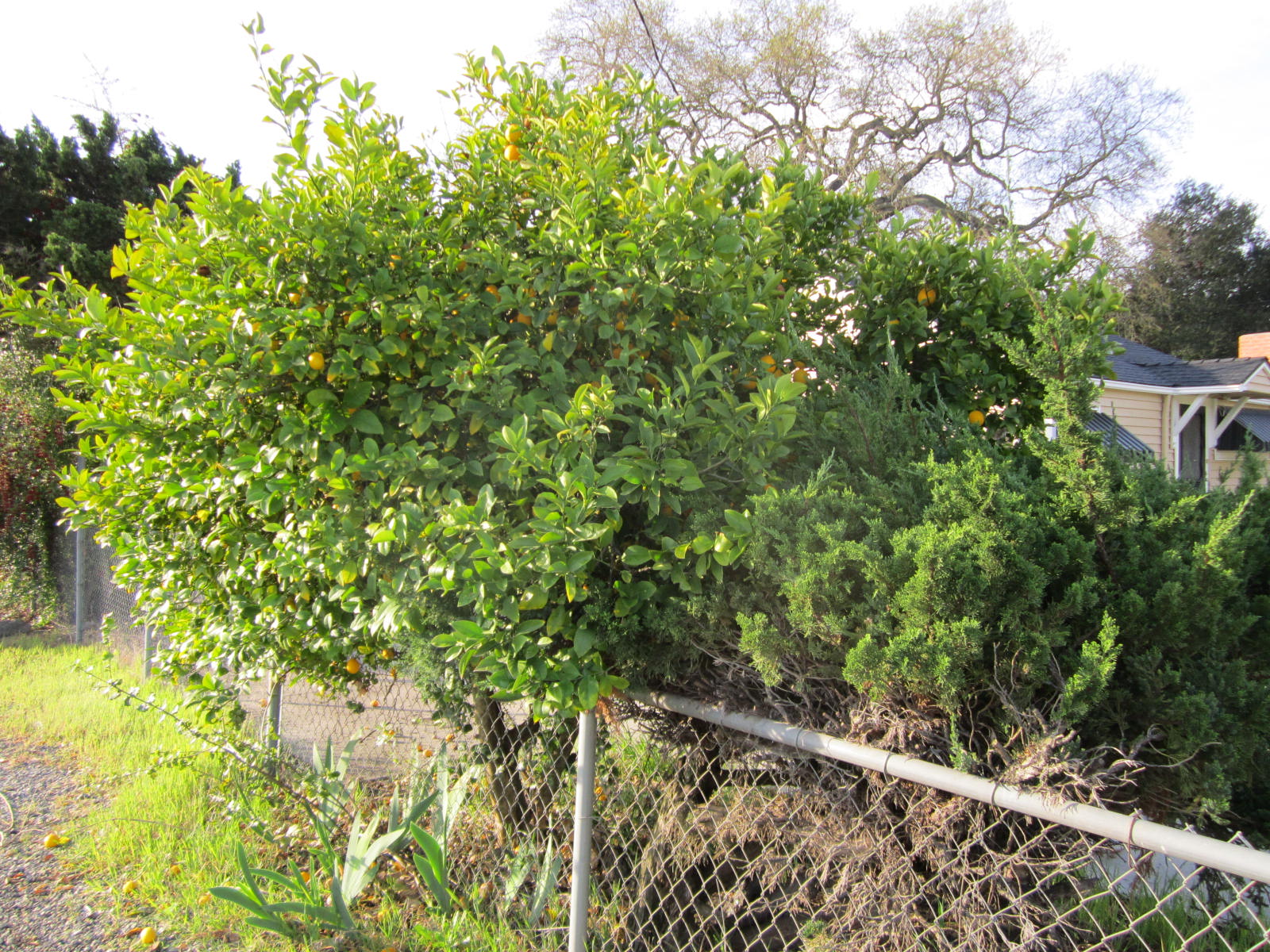
Save some for later! That's the only answer to the bushels of lemons that are falling all over our driveway. We seem to have an ideal climate for growing lemons. When lemon season hits here, there are more lemons than anyone could possibly use.

I've been working on freezing the juice for the times of year when there are none. It's a pretty straightforward process. I just squeezed the lemon juice through a strainer into a big bowl. Then when the bowl seemed full enough, I began pouring it through a funnel into ice cube trays. After it's frozen, I will pop out the lemon cubes and put them in bags for easier storage. Hopefully, we'll be able to break off a cube of lemon juice whenever we need some.

The lemon juice factory
Our wonderful tree. Actually our neighbor's tree coming over onto our side, but they don't mind.

Tuesday, February 12, 2013

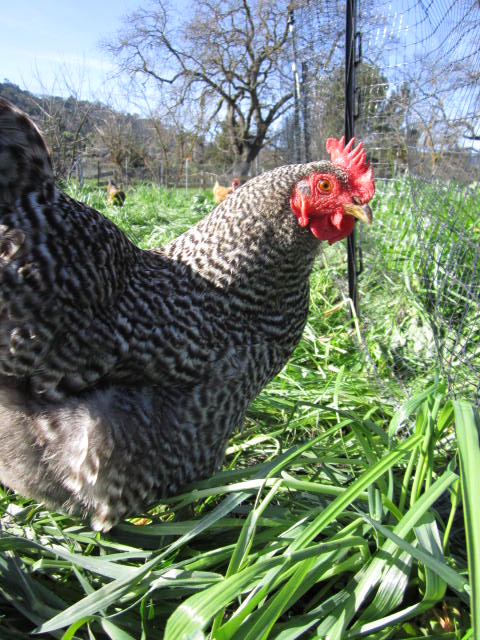
Happy Chickens on New Pasture

Salad up to her knees! They'll have this area looking totally bare in about a month.
Every 2-4 weeks, we move our chickens to a new spot around the farm. This month their pasture is particularly lush. They are virtually swimming in a salad bar of grass, field peas, and fava beans. Lucky ladies! This is our rainy season in California, and thus, our green season.

Rolling coop in a new pasture.
We move them around for a number of reasons. First, it makes chickens happy. They love to eat fresh greens, and the greens in their diet make better eggs and healthier chickens. The only thing they love more than greens is bugs, and they do a lovely job of cleaning up all the pests out of their area. Of course, their manure is an excellent fertilizer, and by moving them around, they distribute it evenly throughout the farm. They even do us the favor of light tillage with their constant scratching and digging.

We built a rolling coop for the purpose of moving the chickens around. Many farmers use electric fencing for pastured animals, but so far we've gotten by using a plastic chicken fencing, about 3 ft tall. It takes us about an hour of work to move them from one pasture to another. It's a bit of a hassle, it seems worth it. 


Monday, January 21, 2013

End of this CSA Season

Our plants look like this most mornings.
This Wednesday, January 23rd, will be the last CSA delivery of the season. We've had frost just about every morning for the past month. The frost, combined with the short day length and wet soil, means that we haven't been able to grow replacement crops for those we are harvesting. It's okay; that's winter, and it's to be expected. We plan to restart our CSA in April, and we'll be notifying everyone by email and Facebook when we're ready to sign-up members again. If you're not already on our contacts list, and you'd like to be, please fill out the membership form http://www.1-acre-farm.blogspot.com/p/sign-up-to-get-veggies-delivered.html

Lots of people have remarked on how nice it will be to have a vacation over the next couple months. Yeah, right. While we do hope to take a vacation (keep fingers crossed), there's still much work to be done in order to keep things running and get ready for spring. The bigger jobs include tilling the soil for spring and summer plantings, growing thousands of seedlings in the greenhouse, pruning fruit trees, and doing winter plantings of asparagus and strawberries. See you in spring!

Thursday, January 3, 2013

Cauliflower, a Long Time Coming

(L-R) Broccoli, Romanesco, and Cauliflower

This week we had a beautiful harvest of cauliflower, broccoli and romanesco! Although most people think of cauliflower as a fairly common veggie, as opposed to something like fancy heirloom tomatoes, cauliflower actually is quite difficult to grow. Once tomatoes are established, they give many pounds of fruit continually for about 3 months. Cauliflower takes just as long to grow (We seeded today’s cauliflower back in July!), and each plant makes only one head. Although the leaves are also edible, most people don’t eat them, so it’s a 1-harvest crop. Cauliflower is a cool-weather crop, and we only grow it in the fall now because we’ve found that spring cauliflower tends get aphids and cabbage loopers, and it bolts (goes to flower) as soon as we get a hot day. The cauliflower we're harvesting now was covered with shade cloth back when the weather was hot and later with another type of row cover to keep it warm and keep the bugs off. Now that we’re getting cold nights, we’ve also lost some of the heads to frost damage. These are a few of the reasons why our fall CSA tends to feature much more leafy greens, like kale, which grows in only 2 months and can be harvested continuously for many months. 
A mature plant is about 3 ft. tall with huge leaves.

I just want folks to have some idea of what it takes to grow a vegetable that most Americans think of as relatively inexpensive and common. How does organic cauliflower arrive at the grocery store year-round for about $3/head? I really don’t know. Surely, it's due in part to economy of scale, i.e. larger farms can grow big fields of cauliflower and mechanize the process. I also think it has a lot to do with importing from other regions and countries when it's out of season here, underpaid farm labor, and maybe climate-controlled greenhouses.

If you have tips for growing cauliflower efficiently, let us know. We're still learning!

Tuesday, December 18, 2012

Annual Survey Results

We've got about a month left to this CSA season!

Last month we conducted our annual survey of CSA members. And the results, drum roll please...

We had 9 surveys returned, not bad out of 13 members! Overall, most people very happy with the CSA. Many people want more fruit, which is understandable. Several people requested more “common” vegetables, like lettuce and carrots. Some of the responses, of course, are in conflict with each other, e.g. people requested both more and less greens and peppers. We will keep doing our best to adjust the CSA to meet the needs of more people. Here is a summary of the survey results:

Which kinds of produce would you like more of?
lettuce (x3), beets (x2), green beans (x2), broccoli (x2), fruit (x4), greens (x3), onions, potatoes (x2), carrots (x3), artichokes, herbs (x2), cauliflower, bell peppers, winter squash, parsnips, rutabagas, tomatoes (x2), okra, corn, “everything!”.
Which kinds of produce would you like less of? 
fava beans, greens, turnips, sunchokes, chives, peppers, hot peppers, eggplant, zucchini.
How was the quality and freshness of the produce? Excellent (89%), Good (11%)
How was the amount of produce? Too Much (12.5%), Just Right (87.5%)
How was the price? Fair Deal (66.7%), A Bargain (33.3%)
What was your top reason(s) for joining a CSA? Health (44.4%), Environmental sustainability (44.4%), Supporting local business (55.6%), Quality of produce (66.7%), Convenience (33.3%), Connection with my food producers and community (77.8%), Seasonal eating (55.6%), Curiosity, (22.2%), Other (33.3%)
How often do you read each of the following? Newsletter (100% very often), Blog postings (33.3% very often, 33.3% sometimes, 33.3% not very often), “What’s in the Bag?” list (44.4% very often, 22.2% sometimes, 33.3% not very often), Facebook postings (37.5% very often, 12.5% sometimes, 25% not very often, 25% never)
Do you plan to join our CSA again next year? Definitely (66.7%), Probably (33.3%)