Saturday, June 8, 2013

Planting and Harvesting Wheat by Hand

One of the new things we tried on the farm this year was growing a small patch of wheat. Although we're not thinking of becoming wheat farmers, I thought it would be interesting to try to grow a grain since they are such a staple in our diet. I'm sharing our process here because I found very little information available about wheat growing on a garden-scale. My disclaimer is that this is our first time growing wheat, so we are definitely not experts on the subject.

We are in USDA zone 9b, and we planted the wheat in October. It's Hard Red Winter Wheat, one of the most common varieties. We planted an area of about 240 square feet. To plant the wheat, we just made furrows with a hoe, sprinkled the seed in and then used the hoe to cover it with soil. We irrigated it with sprinklers until the winter rains came. It was extremely easy to grow and basically looked like grass throughout the winter and early spring. It started making heads in early May.
Heads filling out in mid-May

Next came the critical step of figuring out when to harvest it. Based on what I've read and an introductory workshop at Pie Ranch, I determined that the wheat should be all brown, and the kernels should not be chewy anymore. However, you don't want to wait so long that the plants drop their seed. We began the harvest on May 31st.

Since this is just a small experimental patch, I didn't want to buy any special tools or equipment for harvesting. We ended up using a serrated knife and pruning shears. I think the knife was probably more efficient. We grabbed each handful of wheat near the base and cut through the stalks with the knife. I found that it's easier to start with small bundles, about 3-4 inches in diameter. While holding the bundle in my left hand, I would use my right hand to tie it together. I found the most efficient thing to do was  use a stalk of the wheat to tie it. I would just bend the stalk about halfway up, wrap it tightly around the bundle (twice if possible) and then tuck the end into the wrapped part to secure it in place. Each of these bundles is called a sheaf.

Using a wheat stalk to bind the sheaf
Harvesting a sheaf
 We collected the sheaves in a big box, and when it was full, we brought the sheaves to an open place in the yard and stacked them together into "shocks." Each shock consisted of about 15 sheaves of wheat leaning together, with the seed heads up, so as to hold each other up. The best way I found to do this was to choose four of the larger sheaves and carefully lean them together to form the base. The key is to gently squeeze the heads together, so they tangle up and hold onto each other. Then I just keep adding additional sheaves in sets of two on opposite sides. Finally, I covered the top of the shock with a piece of row cover/remay (cheesecloth would work too). It's not as pretty with the cover, but it'll keep the birds off.
Bringing in the sheaves!
Now we'll wait until the wheat is completely dry, and then we'll begin the process of threshing and winnowing, which will separate the wheat grains from the chaff. To be continued....
Some of the sheaves shown here are covered and some not

Thursday, May 9, 2013

Zucchinis... Coming Right Up!

Thanks to a super-warm spring, our zucchini plants are already quite big, and it looks like we may have our first harvest as early as next week. I'm really happy that they look so good because I nearly lost them after transplanting due to an irrigation mistake.

Around this time of year, I always like to clarify the difference between zucchini, summer squash, and winter squash. The short answer is that there is almost no difference. Summer squash refers to fruits that are harvested before their seeds mature, when their skin is still soft. Zucchini is one kind of summer squash, as is yellow crookneck, pattypan, etc. Winter squash are mature squash fruits with hard skins. Winter squash include butternut, acorn, and spaghetti squash. An immature winter squash is a summer squash, and a way overgrown zucchini becomes like a winter squash. Of course, the varieties we know as summer squash have qualities that make them particularly good for that purpose, and same goes for winter squash. To clarify another common misconception, both are grown in the summer. Winter squash are harvested in the fall, and keep well in storage over the winter, hence the name.
Female squash flower with Golden Zucchini forming underneath.

Male squash flower (no fruit forms beneath it)

Thursday, April 25, 2013

Our New Logo

Here it is, our beautiful new logo!


Look for it wherever the freshest, most delicious produce is sold (within Morgan Hill, that is).

The logo was designed by CSA member Marieke Ruys http://mariekeruys.com. Check out her collection of hand-printed, eco-friendly napkins, the perfect accompaniment to all your locavore meals.

Monday, April 15, 2013

First CSA Delivery of the Season!

The first delivery of the spring season will be this Wednesday, April 17th! I'm getting very excited seeing how well our spring produce is doing right now. The first bag will include: beets, carrots, garlic, lettuce, mustard greens, tatsoi, bok choy, mint, mizuna, artichokes, and lemons.


Perfect for a stir-fry, with lots of Asian greens!

Friday, March 29, 2013

High Tunnel is Up! Many Thanks to our Helpers!

We finished putting on the plastic this morning.
The high tunnel is just about finished, and we wanted to say a huge "thank you" to all of you who helped us make this happen! Special thanks to our WWOOF volunteer, Madeline, who put in several 10-hour+ days on this project and our neighbor, Dan, who gave us free reign of his tool shed all week and to Mike from People and Planet who kept us fueled up with a big box of bananas and apples. Also much thanks to Bart, Pieter, Nineveh, Ariella, Jynelle, Kyrod, Tim, Craig, Lynn, and Nina who all gave up part of their weekend and plenty of sweat to get it done.

Hanging the first door.

Lots of drilling into steel on ladders- hard work!

Shoveling gravel under the baseboards - also a good workout!
Putting up purlins.


Ladders moving everywhere.


More drilling on ladders.

Victorious!


Monday, March 18, 2013

It's a Barn Raising!

Saturday and Sunday March 23rd and 24th, from 10am-5pm

This is the first arch. We have 11 more to go!
Gal has been busy with the sledgehammer.
It’s actually a high-tunnel raising, but same concept. A barn raising is when members of a community come together to help assemble and raise the frame of a barn — or in our case, a high-tunnel — which is too big a job for the farmers to do alone. A high-tunnel is a type of greenhouse, basically a big metal frame covered with plastic, which we will plant under. We were awarded a grant from NRCS to purchase this high-tunnel, and we need to finish assembling it in time for our April planting. So the race is on!

The posts that form the foundation are already in place, and it’s time to put up those big metal hoops. This is a big job, and we are humbly requesting the help of our community of friends, neighbors, and CSA members. You do not have to be an experienced construction worker or super-strong to help out. Jobs will include piecing together the metal hoops, helping to hoist them into place, and bolting together the supporting pieces. If you have a drill, please bring it. Also, we are greatly in need of a tall, free-standing (A-frame) ladder, 10 feet or taller. The barn raising is both Saturday and Sunday. We hugely appreciate any help you can provide, whether for an hour or a day. We hope this will be a fun community-building time with a sense of accomplishment at the end. We will provide cold drinks and light refreshments.

All are welcome. Many hands make light work.

900 W. Edmundson Ave., Morgan Hill

Thank You,
Michelle and Gal

The finished product should look something like this.


Thursday, March 14, 2013

When Life Gives You Lemons....

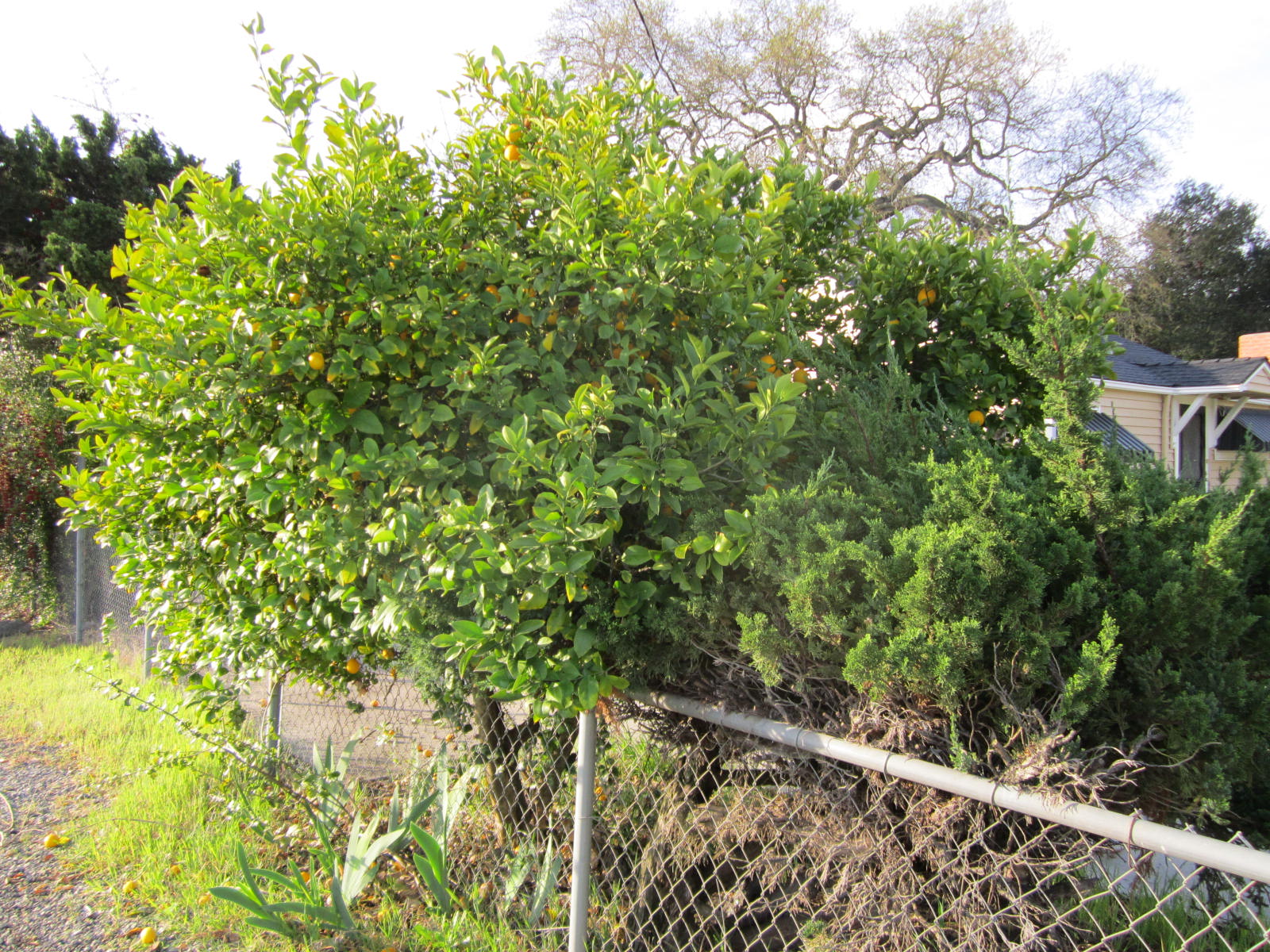
Save some for later! That's the only answer to the bushels of lemons that are falling all over our driveway. We seem to have an ideal climate for growing lemons. When lemon season hits here, there are more lemons than anyone could possibly use.

I've been working on freezing the juice for the times of year when there are none. It's a pretty straightforward process. I just squeezed the lemon juice through a strainer into a big bowl. Then when the bowl seemed full enough, I began pouring it through a funnel into ice cube trays. After it's frozen, I will pop out the lemon cubes and put them in bags for easier storage. Hopefully, we'll be able to break off a cube of lemon juice whenever we need some.

The lemon juice factory
Our wonderful tree. Actually our neighbor's tree coming over onto our side, but they don't mind.