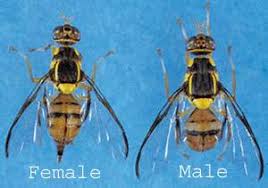
If you live in our area, you may have heard in the news recently about the Oriental Fruit Flies that have been found in Morgan Hill. The Oriental Fruit Fly is an invasive species of insect that destroys many kinds of crops, including tree fruit, tomatoes, cucumbers, and peppers. As of today, four of these flies have been found near Monterey Rd. between Dunne and Tennant. This is frightfully close to our farm and could easily affect our farm and our CSA this year, especially if the county calls for a quarantine of produce.
We want to make sure to share with you (especially our CSA members) what we know about the Oriental Fruit Fly and what our plans are now that it is here. We hope you will read the following Q&A, and contact us if you have additional questions or concerns.
1. Is the Oriental Fruit Fly dangerous to humans?
No, the fruit fly is not dangerous to humans, just to produce, which its larvae basically destroy from the inside.
2. What is a produce quarantine? If the county calls for a quarantine, it means that none of the host crops can leave local farms unless they have been treated to eradicate the Oriental Fruit Fly. On our farm, this would affect tomatoes, peppers, and cucumbers for about 1 month. The purpose of the quarantine is to keep the pests from spreading throughout our area, which could have a devastating effect on agriculture here.
3. Are we under quarantine yet? No, our area is not currently under quarantine, but several Oriental Fruit Flies have been found, and if they find more we will be quarantined.
4. What is being done about the fruit flies? The county is proactively treating for these pests. The treatment involves (excuse the technical language here) shooting gobs of goo high into trees and onto utility poles. The goo contains a pheromone that attracts male fruit flies. They then get stuck in the goo, and a low-level pesticide ensures that they die there. No males = no more fruit flies within one life-cycle.
5. How will you treat for the fruit flies at One Acre Farm? Fortunately, there is an organic-certified pesticide available for this treatment. It's called Spinosad, and it is derived from naturally-occurring bacteria through fermentation. We did some of our own research into this product, and it appears to be very safe to use.
6. What happens to our CSA if the area is quarantined? That will depend in part on the type of quarantine. Some options would be to have smaller CSA bags for a while (without tomatoes, peppers, and cucumbers.... sad, I know). We might be able to supplement more with produce from farms outside the quarantine. We would also offer a refund to those who want one.
Right now, everything is business as usual. Stay tuned, and we'll update you as we learn more. As always, thank you so much for supporting local farms!
Update: As of August 14th, no new fruit flies have been found. This means that we have so far avoided a quarantine. We'll have to keep our fingers crossed for another month though. Meantime, we haven't sprayed the Spinosad because we found out it's quite expensive, about $175/gal.


 One thing we've been interested in lately is whether we can grow a larger portion of our calories here on the farm by growing more things like grains and legumes. These also have the added benefit that they last a long time in storage, so we can eat them and give them to our CSA members over the winter when there are less veggies growing. Last year we grew a small plot of Hutterite beans, which are a white soup bean, somewhat like navy beans. They tasted fantastic and were easy to grow, so this year we planted a lot more.
 1. Shelling (shucking) the beans one by one, splitting the pods open and dropping the beans into a bowl. It takes forever, but the beans come out nice and clean, and we can work on it while watching movies.


